



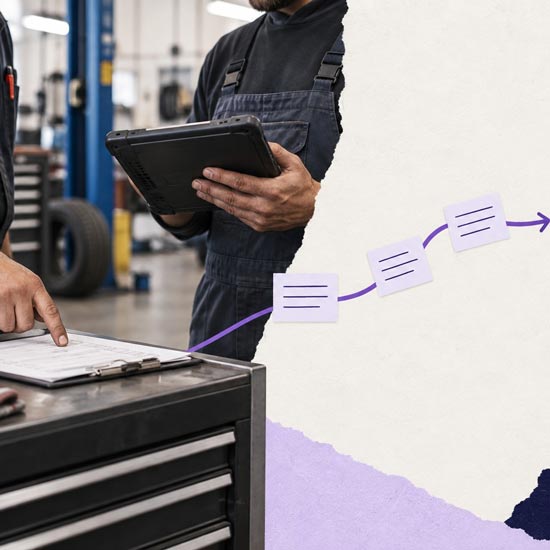

Dealerships lose useful operational insight when employees believe candid answers can be traced back to them.
Technicians often see service department problems before anyone else. They know when a diagnostic process creates repeat work, when training has not kept pace with vehicle technology or when workload pressure encourages shortcuts. Yet a technician may stay quiet if candid feedback could affect assignments, hours, advancement or the relationship with a direct supervisor.
That silence is expensive in a tight labor market. The U.S. Bureau of Labor Statistics projects about 70,000 openings for automotive service technicians and mechanics each year from 2024 through 2034. The National Automobile Dealers Association’s 2025 Dealership Workforce Study reported 31% annualized turnover for B-service technicians in 2024. Better employee listening will not solve every retention problem, but it can reveal preventable friction before an experienced technician leaves.
Small Teams Make Ordinary Details Identifying
Removing names from a survey is only the first step. A service department may have one apprentice, one electric-vehicle specialist or one technician assigned to a particular brand or shift. Filters for location, tenure, role or supervisor can narrow the response to a single person.
Written comments create more clues. A reference to a difficult repair order, a recent comeback, a tooling request or a specific training course may immediately identify the author. A live dashboard can add timing clues when a score changes just after a known employee responds.
The National Institute of Standards and Technology makes the broader point in Special Publication 800-188: Removing direct identifiers does not eliminate disclosure risk when other information can be linked back to an individual. In a dealership survey, the report shown to leaders needs as much protection as the questionnaire itself.
Protect The Report, Not Only the Survey Link
Dealerships can preserve useful insight with a few firm reporting rules:
- Set minimum group sizes before the survey opens. If a team is too small, combine its results with a larger eligible group.
- Limit repeated filtering. Department, rooftop, role, shift and tenure may become identifying when combined.
- Release results after the response window closes rather than updating a live dashboard.
- Summarize recurring themes instead of publishing distinctive comments word for word.
- Remove individual-response exports and administrator overrides. An anonymity setting controlled by management asks employees to trust a switch they cannot see.
These safeguards reduce detail, but not value. A small team’s responses can strengthen a dealership-wide finding even when a separate chart would expose the people behind it.
Use Feedback to Improve the Process
Anonymous feedback is designed to identify patterns and test whether systems are working. It is not designed to resolve a problem for one employee or to establish that one comment is the complete account of an event.
Suppose one technician reports that time pressure is leading to skipped quality checks. The wrong response is to identify the commenter. The useful response is to review workload planning, inspection steps, flat-rate incentives, supervisor expectations and comeback data. Leaders can then communicate what changed and monitor whether the concern recurs.
Separate confidential channels should remain available for employees who need an individual response. Those channels should be explained before the survey, not opened by tracing an anonymous comment back to its author.
Technician feedback becomes operationally useful when employees can describe a pattern without gambling their identity. The result is not merely a better survey. It is earlier visibility into the processes that affect quality, safety, retention and customer trust.
Keith Player is the founder of Candora. His work combines product, software and operations experience to help organizations collect candid employee feedback without exposing individual responses.
Sources
U.S. Bureau of Labor Statistics, Automotive Service Technicians and Mechanics, Occupational Outlook Handbook: https://www.bls.gov/ooh/installation-maintenance-and-repair/automotive-service-technicians-and-mechanics.htm
National Automobile Dealers Association, 2025 Dealership Workforce Study: 2024 Total Turnover and Retention Trends: https://www.nada.org/media/18376/download
National Institute of Standards and Technology, SP 800-188, De-Identifying Government Datasets: Techniques and Governance: https://csrc.nist.gov/pubs/sp/800/188/final